Día de los Muertos for Kids: 12 Family Activities to Learn Spanish & Celebrate (Free Printable)
28 de septiembre de 2026
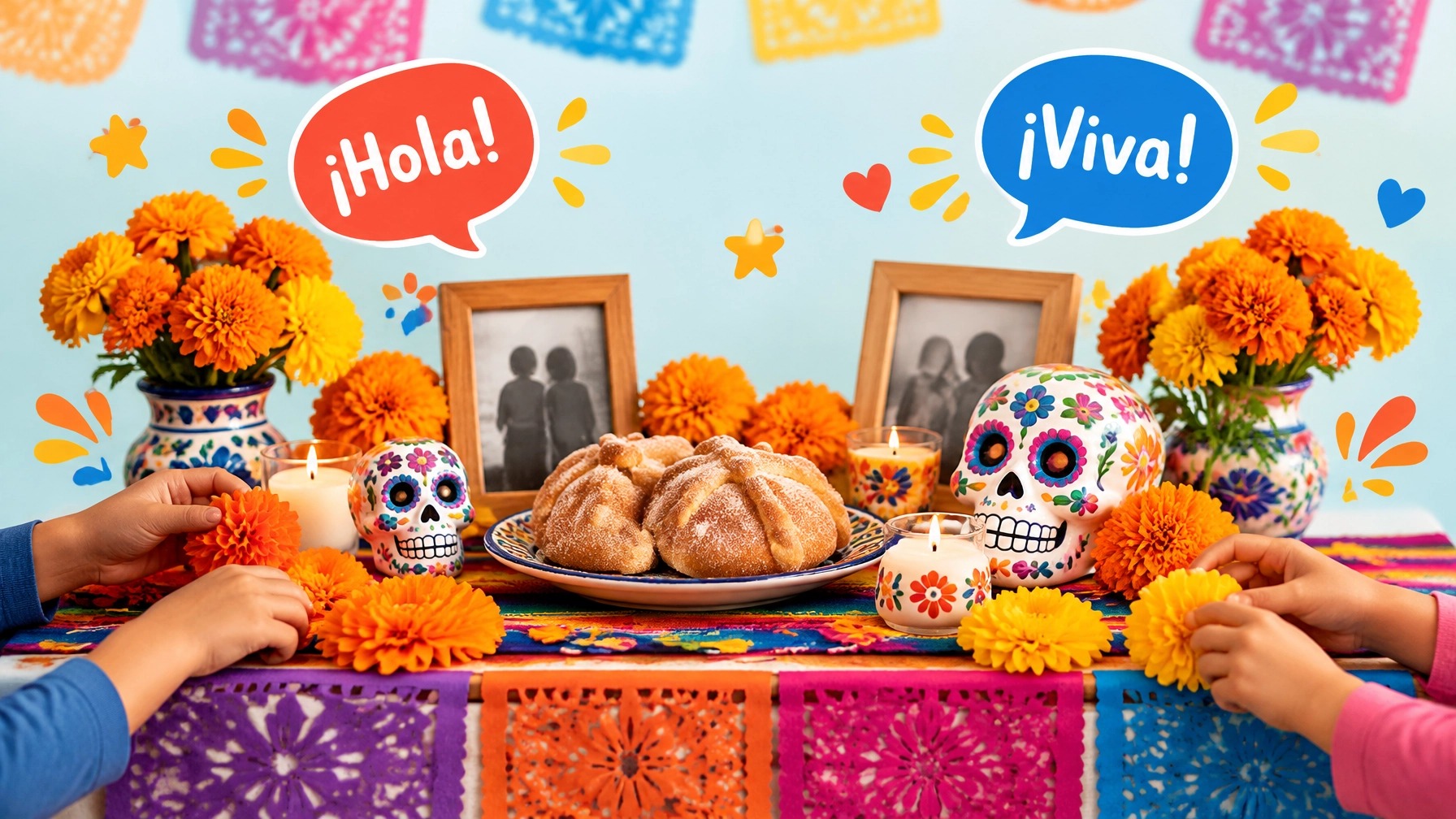
¡Hola, familias! Día de los Muertos is coming November 1–2, and it is the perfect time for meaningful family learning, creativity, and Spanish practice. 🤍
This beautiful Mexican tradition invites families to remember and honor loved ones who have died. It is filled with color, music, flowers, food, stories, and love.
It is not Mexican Halloween. Halloween, celebrated on October 31, has different origins and traditions. Día de los Muertos is primarily Mexican and centers on remembrance and connection. Other Latin American countries have their own related traditions for honoring loved ones, too, so it is important not to treat all of Latin America as one culture.
Ready to celebrate respectfully at home? Here are 12 fun Spanish activities for kids ages 3–12!
A few Spanish words to begin
- Día de los Muertos — Day of the Dead
- ofrenda — offering or remembrance altar
- cempasúchil — marigold flower
- pan de muerto — traditional Day of the Dead bread
- calavera — skull
- vela — candle
- foto — photo
- recuerdo — memory
- familia — family
- amor — love
For young children, keep explanations simple: “We use an ofrenda to remember people we love.”
For additional cultural context, explore the Smithsonian’s Day of the Dead learning resources and its helpful explanation that Día de los Muertos is distinct from Halloween.
1. Make a cempasúchil flower hunt
Cempasúchil flowers are bright orange and yellow marigolds. Many families place them on an ofrenda. Their color and scent are traditionally connected with guiding loved ones home.
Buy a small bunch of marigolds, look for them in your neighborhood, or make paper flowers together.
Practice:
- la flor — the flower
- naranja — orange
- amarillo — yellow
- huele bien — it smells good
Say: “Esta es una flor de cempasúchil.” — “This is a marigold flower.”
Preschool tip: Sort flowers by color and count them in Spanish: uno, dos, tres.
2. Create colorful papel picado
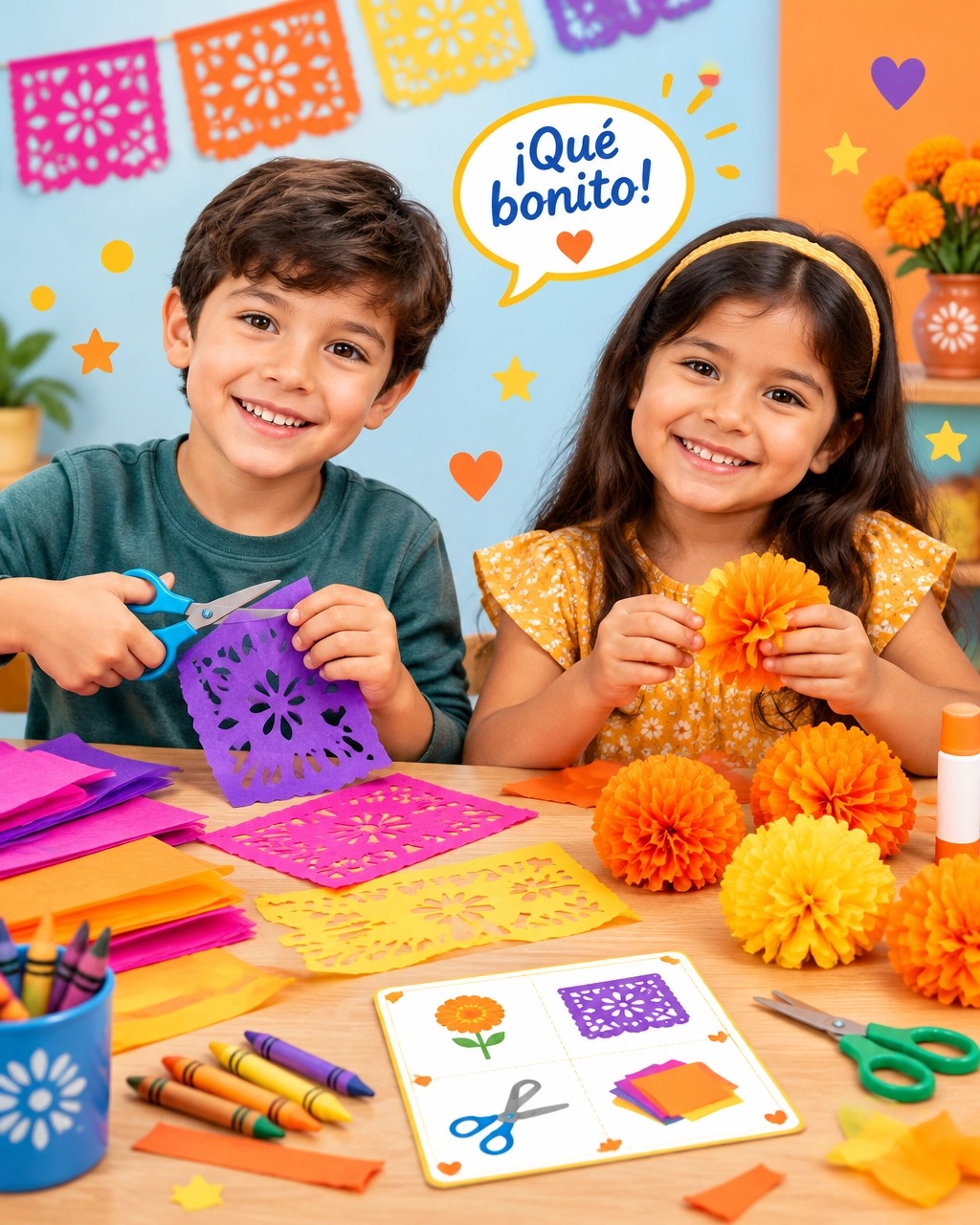
Papel picado means “perforated paper.” These delicate banners are made by folding and cutting colorful tissue paper.
Use child-safe scissors. Fold paper, cut simple shapes, and unfold it to reveal a pattern. Add hearts, circles, stars, and flowers. Then hang the banner across a wall or above your family table.
Practice:
- papel — paper
- cortar — to cut
- doblar — to fold
- corazón — heart
- círculo — circle
Try these phrases:
- “Corta el papel.” — Cut the paper.
- “¿De qué color es?” — What color is it?
- “¡Qué bonito!” — How beautiful!
3. Build a small family ofrenda
An ofrenda can be simple. You do not need a large display. A small table or shelf works beautifully.
Invite children to help choose:
- A foto of a loved one who has died
- A favorite object, toy, or book
- Flores or paper marigolds
- Agua — water
- Pan de muerto
- Battery-operated velas — candles
- A meaningful drawing or note
Explain that each item has a purpose. The ofrenda is a loving way to remember someone’s life and personality.
Practice: “Esta es la foto de mi abuela.” — “This is my grandmother’s photo.”
Safety note: Use battery candles around young children. Let children participate only in ways that feel emotionally comfortable for your family.
4. Bake or decorate pan de muerto
Pan de muerto is a sweet bread traditionally enjoyed during Día de los Muertos. You can purchase one from a bakery or make a simple family version.
Easy kid-friendly pan de muerto-inspired recipe
Ingredients:
- 1 package refrigerated dinner-roll dough or sweet bread dough
- 1 tablespoon melted butter
- 2 tablespoons sugar
- A little orange zest
- Optional: cinnamon
Steps:
- Let children shape pieces of dough into small round buns.
- Roll tiny strips to make “bone” shapes and place them on top.
- An adult bakes the bread according to the package directions.
- Brush with melted butter.
- Sprinkle with sugar, orange zest, and cinnamon.
Say:
- “Vamos a mezclar.” — Let’s mix.
- “Vamos a decorar.” — Let’s decorate.
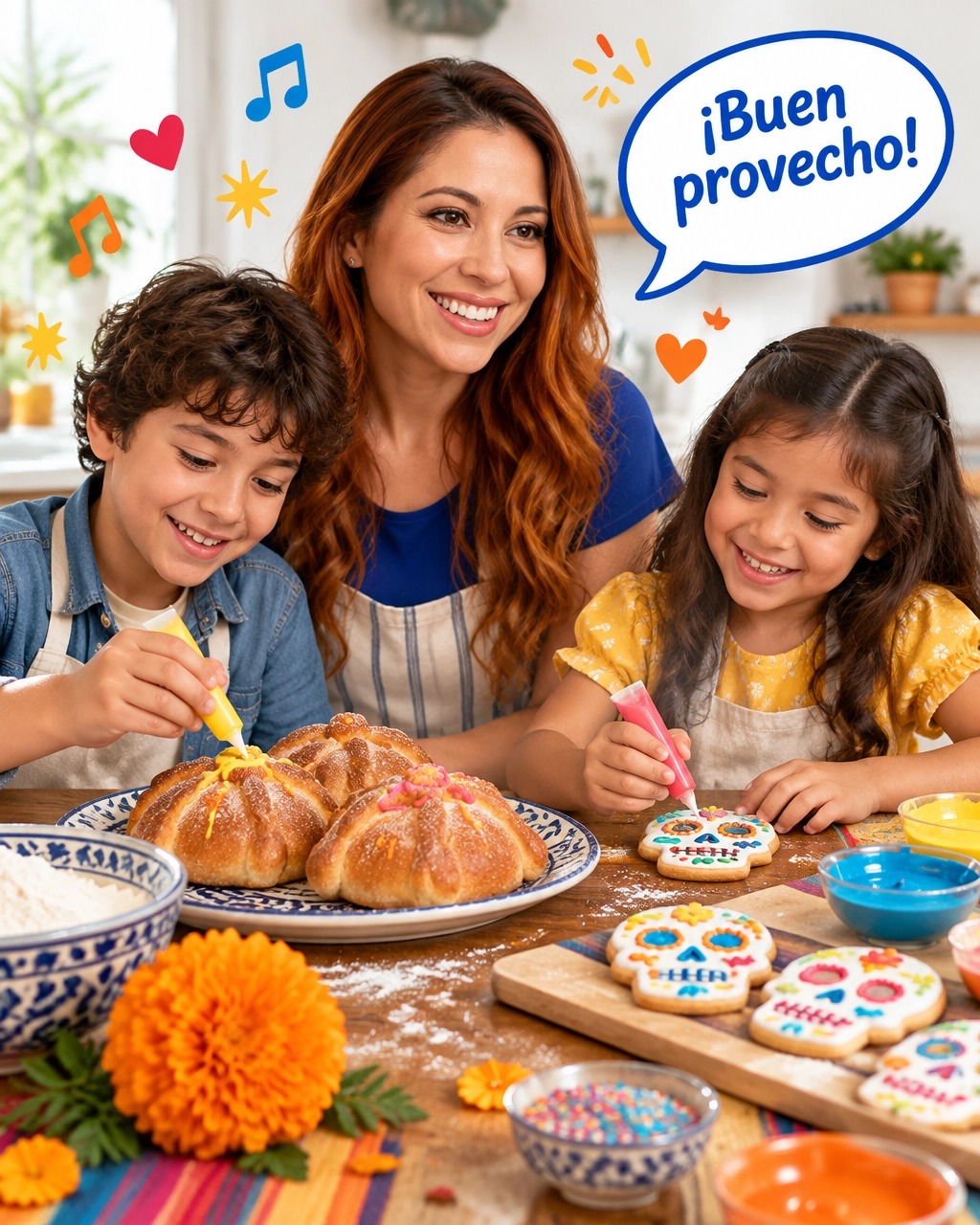
- “¡Buen provecho!” — Enjoy your meal!
5. Decorate calaveras de azúcar
Calaveras de azúcar are colorful sugar skulls. They are often decorated with bright icing, flowers, hearts, and playful patterns.
For younger children, use a skull coloring page or paper cutout. Older children can decorate cardboard skulls with markers, tissue paper, and stickers.
Practice:
- calavera — skull
- colores — colors
- ojos — eyes
- flores — flowers
- brillante — bright
Use the phrase: “Mi calavera es azul y naranja.” — “My skull is blue and orange.”
Focus on creativity and meaning, not scary effects or costumes.
6. Write a bilingual calaverita literaria
A calaverita literaria is a playful Mexican poem traditionally written about death. With children, keep it gentle, silly, and age-appropriate.
Choose a favorite fictional character, family pet, or friendly skeleton. Write four short lines. Rhymes are optional!
La calavera fue a jugar,
con sus amigos al bailar.
Comió pan y dijo: “¡Qué emoción!”
¡Volvió cantando una canción!
Practice:
- poema — poem
- rima — rhyme
- bailar — to dance
- cantar — to sing
Older children can write a bilingual version. Preschoolers can dictate a sentence while an adult writes it down.
7. Play Día de los Muertos bingo or memory
Make cards with pictures of:
- flor — flower
- vela — candle
- foto — photo
- pan — bread
- calavera — skull
- familia — family
- ofrenda — offering
- papel picado — cut-paper banner
For a memory game, create two cards for each word. Turn them face down and name each picture when a child flips it.
Say: “Encontré una calavera.” — “I found a skull.”
This is one of the easiest interactive Spanish lessons for children because kids hear, repeat, move, and play.
8. Share a family photo and heritage story
Choose one photo of a loved one. Ask children:
- Who is in the photo?
- What did they enjoy?
- What made them laugh?
- What family tradition do you remember?
Create a small bilingual caption:
- “Esta es mi familia.” — This is my family.
- “A mi abuelo le gustaba la música.” — My grandfather liked music.
- “Lo recuerdo con amor.” — I remember him with love.
If your family does not observe Día de los Muertos, you can learn about the tradition without pretending it belongs to you. Read Mexican-authored books, listen to Mexican educators, and talk about how families around the world remember loved ones in different ways.
9. Listen to music and move together
Play a gentle, age-appropriate version of “La Llorona,” a well-known Mexican folk song, or explore other Mexican folk songs and regional music.
Explain that La Llorona is also the name of a Mexican legend. The song and the legend are related cultural topics, but La Llorona is not the meaning of Día de los Muertos.
Try a movement game:
- escucha — listen
- canta — sing
- baila — dance
- rápido — fast
- despacio — slowly
Ask: “¿Te gusta la música?” — “Do you like the music?”
10. Take a virtual Frida Kahlo house tour
Día de los Muertos is a wonderful starting point for exploring Mexican art. Look at Frida Kahlo’s colorful paintings, animals, plants, clothing, and self-portraits.
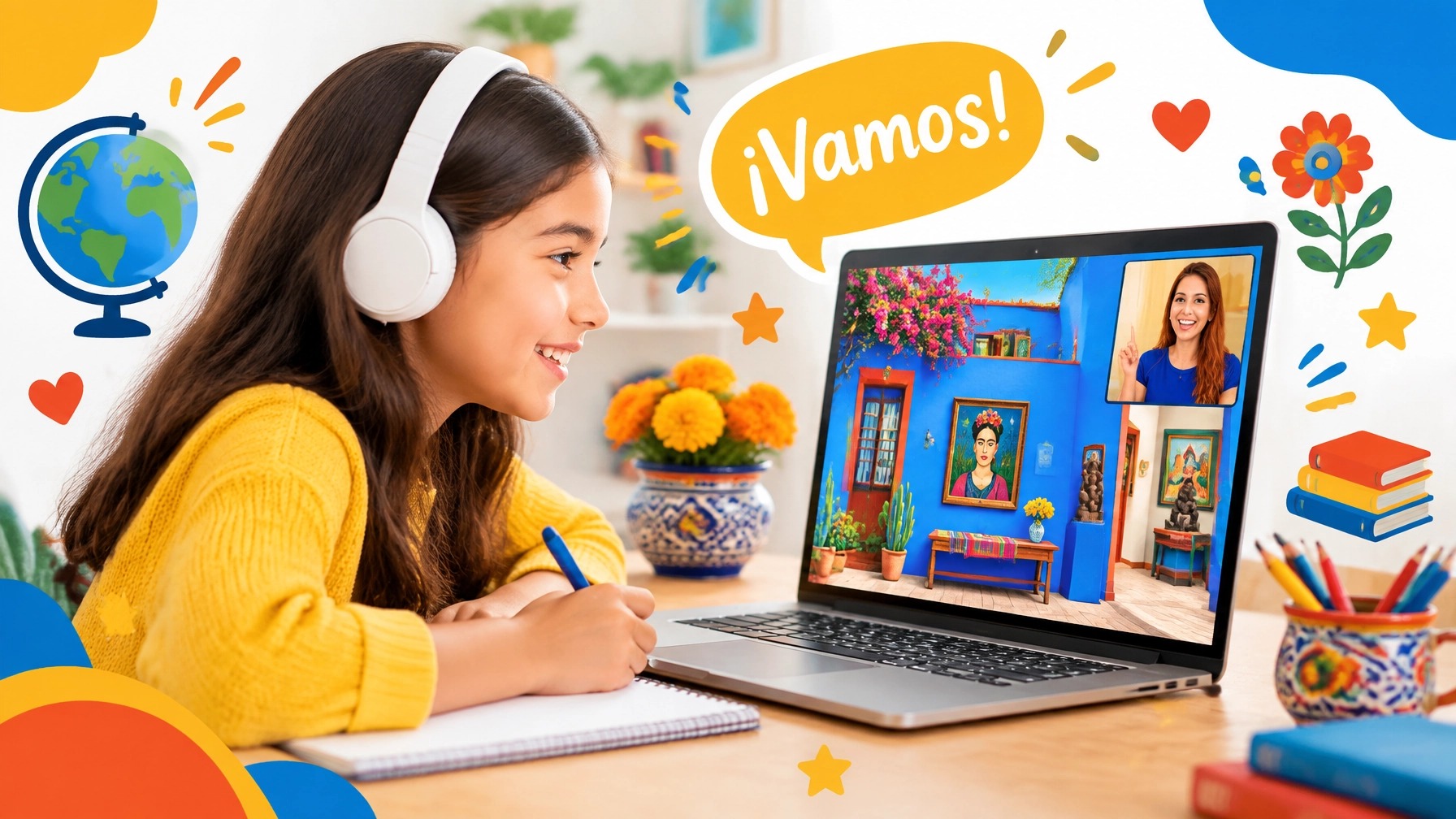
Spanish the Fun Way Academy offers a Spanish Virtual Tour of Frida Kahlo’s House for children ages 6–10. Students explore culture and art with a Spanish teacher from Mexico.
At home, create a mini museum. Children can draw a self-portrait and label it:
- “Yo con flores.” — Me with flowers.
- “Mi autorretrato.” — My self-portrait.
- “Mi museo.” — My museum.
11. Make a memory jar
Decorate a jar with paper flowers and colorful shapes. Then invite each family member to write or draw a memory.
Preschoolers can draw a face, animal, favorite food, or happy moment. Elementary-age children can write full sentences.
Add notes such as:
- “Recuerdo cuando…” — I remember when…
- “Me gusta…” — I like…
- “Gracias por…” — Thank you for…
Place the jar near your ofrenda or family table and read a few memories together.
12. Read a gentle bilingual story
Choose a children’s book about family, remembrance, Mexican culture, or Día de los Muertos. Read one page in English and repeat a key sentence in Spanish.
For an older child, you can include a gentle retelling of La Llorona as a legend. Make it clear that it is a story, not a fact. Avoid frightening details for preschoolers.
Practice:
- cuento — story
- leyenda — legend
- leer — to read
- escuchar — to listen
- pregunta — question
Ask: “¿Qué pasó en el cuento?” — “What happened in the story?”
Free printable: 12-activity family checklist
Print this section or save it as a PDF for your celebration!
- Learn five Día de los Muertos words
- Find or make cempasúchil flowers
- Create papel picado
- Build a small ofrenda
- Bake or decorate pan de muerto
- Decorate a calavera
- Write a calaverita literaria
- Play Spanish bingo or memory
- Share a family photo and story
- Listen to Mexican music
- Explore Mexican art or take a Frida Kahlo virtual tour
- Make a memory jar or read a bilingual story
Frequently asked questions about Día de los Muertos for kids
What is Día de los Muertos, and is it the same as Halloween?
No. Día de los Muertos (Day of the Dead) is a primarily Mexican tradition celebrated November 1–2 that honors loved ones who have died. It is full of color, flowers, food, music, and remembrance. Halloween on October 31 has different origins and customs, so it is best to keep the two separate when explaining them to children.
Is Día de los Muertos appropriate for young children?
Yes, when it is explained gently. Focus on remembrance, family, flowers, art, and food rather than frightening imagery. Preschoolers can enjoy the flowers, paper crafts, music, and simple vocabulary. Older children can go deeper into the history, the poetry, and the meaning behind the ofrenda.
Do we have to be Mexican to celebrate or learn about it?
Día de los Muertos is a living Mexican tradition, so the respectful approach is to learn about it with curiosity and credit. Read Mexican-authored books, learn from Mexican teachers and creators, and be honest with your child that this is a tradition from another culture. You can appreciate it without claiming it.
What are other Latin American traditions for honoring loved ones?
Many countries have their own observances, and they are not all the same. Ecuador has Día de los Difuntos, Guatemala has giant kite festivals, and parts of Spain and other regions hold their own remembrance customs. Learning one or two of these with your child is a great way to avoid treating all of Latin America as a single culture.
How do I teach Spanish through these activities if I do not speak Spanish myself?
You only need a handful of words per activity. Label what you see (flor, vela, foto), use short phrases (“¿De qué color es?”), and let your child repeat them back. If you want a teacher to lead the way, live classes with native Spanish-speaking instructors give your child consistent, playful practice.
How many words can a child realistically learn from this?
With one or two activities, expect five to ten new words to stick, especially if you repeat them over several days. Kids learn vocabulary best through doing, so crafts, cooking, and games do more than flashcards.
Make Spanish part of your family’s everyday fun
You do not need perfect Spanish or an elaborate altar to make this experience meaningful. Start with one activity. Add a few words. Ask questions. Follow your child’s curiosity. ¡Así se aprende!
If you are looking for more fun Spanish activities for kids, Spanish the Fun Way Academy offers live, engaging classes with native Spanish-speaking teachers. Explore our Spanish programs for preschoolers, elementary learners, teens, and homeschoolers, plus more free resources here at Spanish.Education.
Ready to enroll? Use code SPANISH20 for 20% off your child’s first class.
Classes are filling fast, and spots are limited! Give your child a joyful way to speak Spanish, explore culture, and learn with confidence. ¡Viva el Español! 🇲🇽 ❤️