Duolingo vs. Live Spanish Classes for Kids: Which One Actually Gets Your Child Talking?
10 de septiembre de 2026
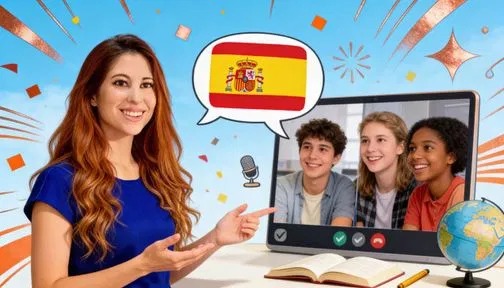
Your child can recognize manzana (apple), perro (dog), and hola (hello) on a screen. ¡Excelente! 🎉
But what happens when someone asks, “¿Cómo estás?” (How are you?)
If your child freezes, whispers, or answers in English, you have discovered the biggest difference between language recognition and real communication.
Recognition is not conversation.
Duolingo and other language apps can be fun tools for building vocabulary and daily habits. But if your goal is for your child to speak Spanish confidently, respond naturally, and enjoy real conversations, live instruction with native Spanish teachers for kids is the clear winner.
Let’s compare both options! 🌟
Duolingo vs. Live Spanish Classes: The Quick Answer
| Feature | Duolingo or language apps | Live Spanish classes |
|---|---|---|
| Vocabulary recognition | Strong | Strong, with context |
| Daily practice | Easy and flexible | Structured and consistent |
| Real conversation | Limited | Excellent |
| Feature | Duolingo or language apps | Live Spanish classes |
|---|---|---|
| Pronunciation feedback | Automated | Immediate and personalized |
| Social interaction | Minimal or none | Built into every lesson |
| Cultural learning | Limited | Stories, music, traditions, and real-world context |
| Personalization | Algorithm-based | Teacher-led and child-centered |
| Motivation | Points, badges, and streaks | Connection, encouragement, games, and friendships |
| Best use | Supplementary practice | Primary path to speaking fluency |
The winner for conversation? Live classes with a native teacher. ¡Sin duda! (Without a doubt!)
Apps can support your child’s learning journey. They should not be the entire journey.
What Duolingo Does Well for Kids
Let’s be fair. Duolingo can be useful! Its colorful design and short activities make Spanish feel approachable.
For many children, an app is a good first step. It can help your child:
-
Recognize common Spanish words.
-
Practice basic sentence patterns.
-
Review vocabulary for a few minutes each day.
-
Build a learning habit.
-
Enjoy a low-pressure introduction to Spanish.
-
Practice anywhere: from the car to the kitchen table! 🚗
A child who uses an app may quickly learn to identify colors, numbers, animals, and simple phrases. That early exposure matters.
However, recognizing a word is different from retrieving it during a real conversation.
Your child may know that rojo means red. But can they say, “Mi camiseta es roja” (My shirt is red) when a teacher asks them a surprise question? Can they understand a classmate? Can they ask, “¿Qué te gusta hacer?” (What do you like to do?) That leap: from recognition to communication: is where live interaction makes all the difference.
The “Recognition Is Not Conversation” Problem
Language learning has both passive and active skills.
Passive skills include recognizing words while reading or listening.
Active skills include speaking, responding, asking questions, and expressing an original thought.
Apps are often strongest at passive recognition. Your child sees a word, chooses an answer, or repeats a phrase. That is helpful practice, but the conversation is predictable.
Real people are not predictable! That’s the fun part. 😄
A live teacher might ask:
-
“¿Qué hiciste ayer?” (What did you do yesterday?)
-
“¿Cuál es tu comida favorita?” (What is your favorite food?)
-
“¿Por qué te gusta ese animal?” (Why do you like that animal?)
Your child must listen carefully. Think. Respond. Try again. Maybe laugh at a mistake. Maybe discover a new way to express an idea.
This is how children develop conversational confidence.
They learn to handle pauses, follow-up questions, pronunciation, turn-taking, and the occasional “¿Puedes repetir?” (Can you repeat that?). These skills cannot be fully developed by tapping through isolated exercises.
Why Native Spanish Teachers for Kids Make a Difference
A native Spanish teacher brings much more than correct vocabulary.
They bring natural pronunciation, authentic expressions, cultural knowledge, and the ability to adjust every conversation to your child’s level.
At Spanish the Fun Way Academy, our expert teachers help children speak Spanish from day one through:
-
Games and movement activities.
-
Songs and music.
-
Interactive stories.
-
Role-play and pretend play.
-
Show-and-tell conversations.
-
Scavenger hunts.
-
Cultural activities and virtual tours.
-
Age-appropriate real-world situations.
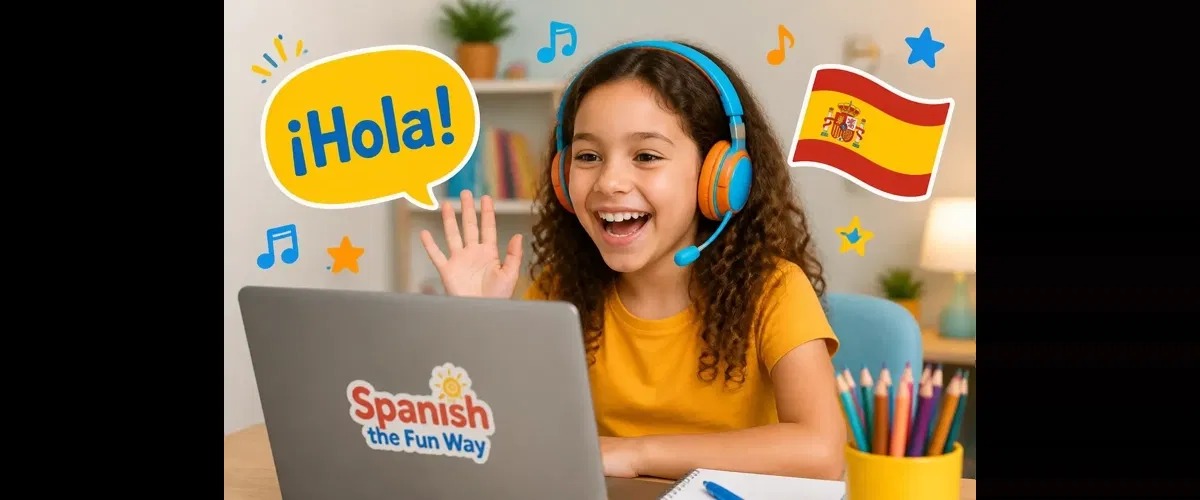
A native teacher also hears the details an app may miss.
Maybe your child is pronouncing a sound incorrectly. Maybe they understand the words but need help building a full sentence. Maybe they are nervous and need a little encouragement.
A teacher can respond immediately:
“¡Muy bien! Try it one more time.”
“Casi.” (Almost.)
“Great idea! How can we add one more detail?”
That human feedback builds both accuracy and courage. Your child learns that mistakes are not failures. They are part of becoming a confident speaker. ❤
App Fatigue Is Real
Gamification can motivate children. Points, rewards, levels, and streaks can make practice feel exciting at first.
But after a while, the same format may become repetitive.
Tap. Match. Translate. Repeat.
Some children love the routine. Others experience app fatigue. The streak becomes pressure. The activities begin to feel like homework. Eventually, the app gets ignored.
Live classes keep learning dynamic because the teacher can change the energy in the moment.
If your child is tired, the class can include a song or movement game. If your child is ready for a challenge, the teacher can ask more advanced questions. If dinosaurs are the current obsession, the lesson can include dinosaurios. 🦖
That flexibility matters, especially for younger learners. Children do not learn best by sitting still and completing endless drills. They learn through curiosity, emotion, repetition, play, and connection.
Interactive Spanish Lessons for Children Build Confidence
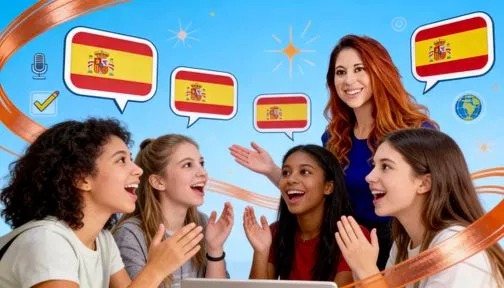
The best interactive Spanish lessons for children make kids active participants: not passive viewers.
In a live class, your child may:
1.Greet the teacher in Spanish. 2.Answer a question using a complete sentence. 3.Listen to classmates. 4.Play a vocabulary game. 5.Act out a story. 6.Ask for help or clarification. 7.Share an opinion. 8.Celebrate a new phrase.
Each small interaction becomes a speaking win.
Over time, your child begins to understand that Spanish is not just a school subject. It is a tool for connecting with people, exploring culture, telling stories, and expressing personality.
That emotional connection is powerful. A child who loves Spanish is more likely to keep practicing Spanish. ¡Qué bonito! (How wonderful!)
What About Cost and Convenience?
Duolingo is convenient and inexpensive. There is no schedule to coordinate, and your child can practice for five or ten minutes whenever you have time.
That makes it a useful supplement. Live classes require a commitment, but they offer something an app cannot: a real teacher who is present, prepared, and focused on helping your child communicate.
Spanish the Fun Way Academy offers flexible options for families, including:
-
Group classes.
-
Small-group and semi-private courses.
-
1-on-1 private tutoring.
-
Preschool Spanish.
-
Elementary Spanish.
-
Spanish for tweens and teens.
-
Conversation clubs.
-
Ongoing courses meeting 1x, 2x, 5x, or 7x per week.
-
Spanish through music and culture.
-
Seasonal camps and storytelling.
-
Special experiences such as virtual tours and movie camps.
You can explore live Spanish classes with Spanish the Fun Way Academy on Outschool. The academy is rated 4.8 stars with more than 1,000 reviews on its Outschool educator profile, with classes for learners ages 3–18.
The Best Strategy: Live Classes First, Apps Second
You do not have to delete Duolingo! 🎉
The strongest approach for many families is a hybrid model:
1. Make live classes the foundation
Use live instruction to develop:
-
Speaking confidence.
-
Listening comprehension.
-
Pronunciation.
-
Real-time conversation.
-
Cultural understanding.
-
Personalized learning habits.
2. Use an app as a short review tool
A few minutes of app practice can reinforce:
-
New vocabulary.
-
Spelling.
-
Numbers and colors.
-
Basic sentence patterns.
-
Previously learned material.
Think of the app as a quick Spanish snack. Live classes are the nourishing, delicious meal! 🌮
For more perspective on why children need interaction and human feedback, read AI Apps vs. Live Spanish Classes for Kids on Spanish.education.
Which Option Should Your Family Choose?
Choose an app as a starting point if your child:
-
Is curious about Spanish.
-
Enjoys independent practice.
-
Needs a quick daily review.
-
Is not ready for a scheduled class yet.
Choose live classes if your child:
-
Needs encouragement to speak.
-
Wants to learn through games, songs, and stories.
-
Benefits from a real teacher’s feedback.
-
Is preparing for travel or bilingual communication.
-
Needs structured homeschool or after-school enrichment.
-
Wants to move beyond memorized words.
-
Is ready to speak Spanish from day one.
For most families who want real fluency, the answer is clear:
Live conversation with native teachers should come first.
Your child deserves more than a streak. They deserve the confidence to say, “¡Hola! Me llamo…” and keep the conversation going! 🌎✨
Ready to Help Your Child Start Speaking Spanish?
At Spanish the Fun Way Academy, we make language learning fun, welcoming, and wonderfully interactive. Our native Spanish teachers for kids create a supportive space where beginners can participate right away and advanced learners can keep growing.
Find your child’s next live Spanish class on Outschool and use promo code SPANISH20 when eligible to save on your first class.
Spots are limited and popular classes may fill fast! ¡Nos vemos en clase! (See you in class!) 🇪🇸🇲🇽❤