Hispanic Heritage Month for Kids: 15 Fun Ways to Celebrate Culture & Spanish at Home
10 de septiembre de 2026
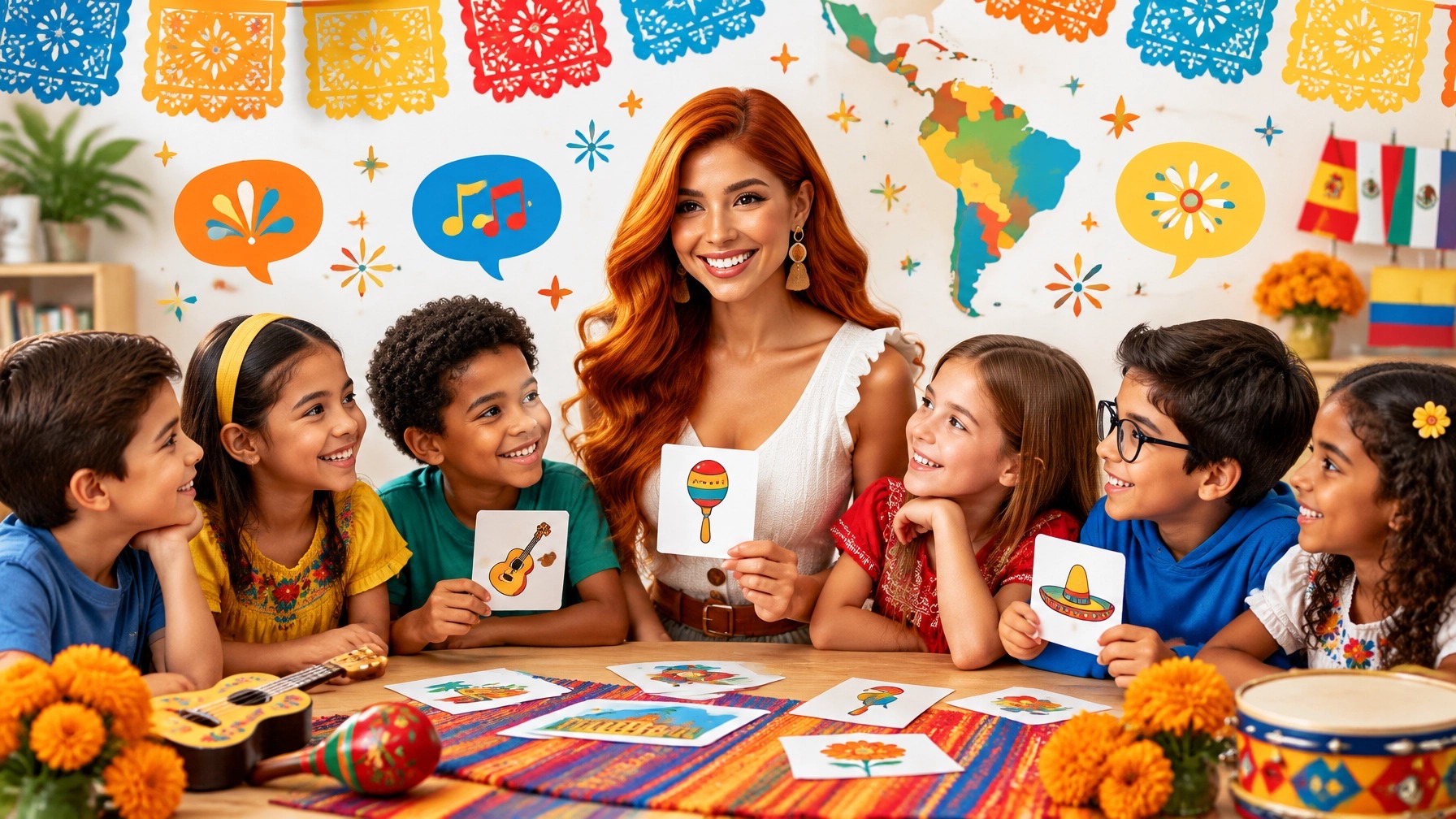
¡Hola, amigos! Hispanic Heritage Month is the perfect time to celebrate the many cultures, stories, languages, and contributions connected to Spanish-speaking communities. In the United States, Hispanic Heritage Month runs from September 15 through October 15, 2026.
And celebration is the key word! This does not need to feel like another school assignment. You can enjoy music, stories, food, games, art, and Spanish together as a family. Every activity can spark curiosity and connection. 💛
Hispanic and Latino communities are wonderfully diverse. They include people and traditions connected to Spain, Mexico, Central America, South America, the Caribbean, and communities throughout the United States. There is no single “Hispanic” experience, and that diversity is something to celebrate!
Here are 15 fun Spanish activities for kids to enjoy at home.
1. Create a Spanish-speaking country passport
Choose a few Spanish-speaking countries and make a simple “passport” from folded paper.
Explore one country at a time, such as:
-
Mexico
-
Spain
-
Colombia
-
Argentina
-
Peru
-
Ecuador
-
The Dominican Republic
For each country, add:
-
Its name and capital city
-
A flag
-
One landmark
-
A traditional food
-
A Spanish word or greeting
Try saying, “¡Hola, México!” or “¡Buenos días, Colombia!” as you begin each page.
The goal is not to memorize facts. It is to notice that Spanish is spoken across many different places, with different accents, foods, music, and traditions.
2. Make a papel picado banner
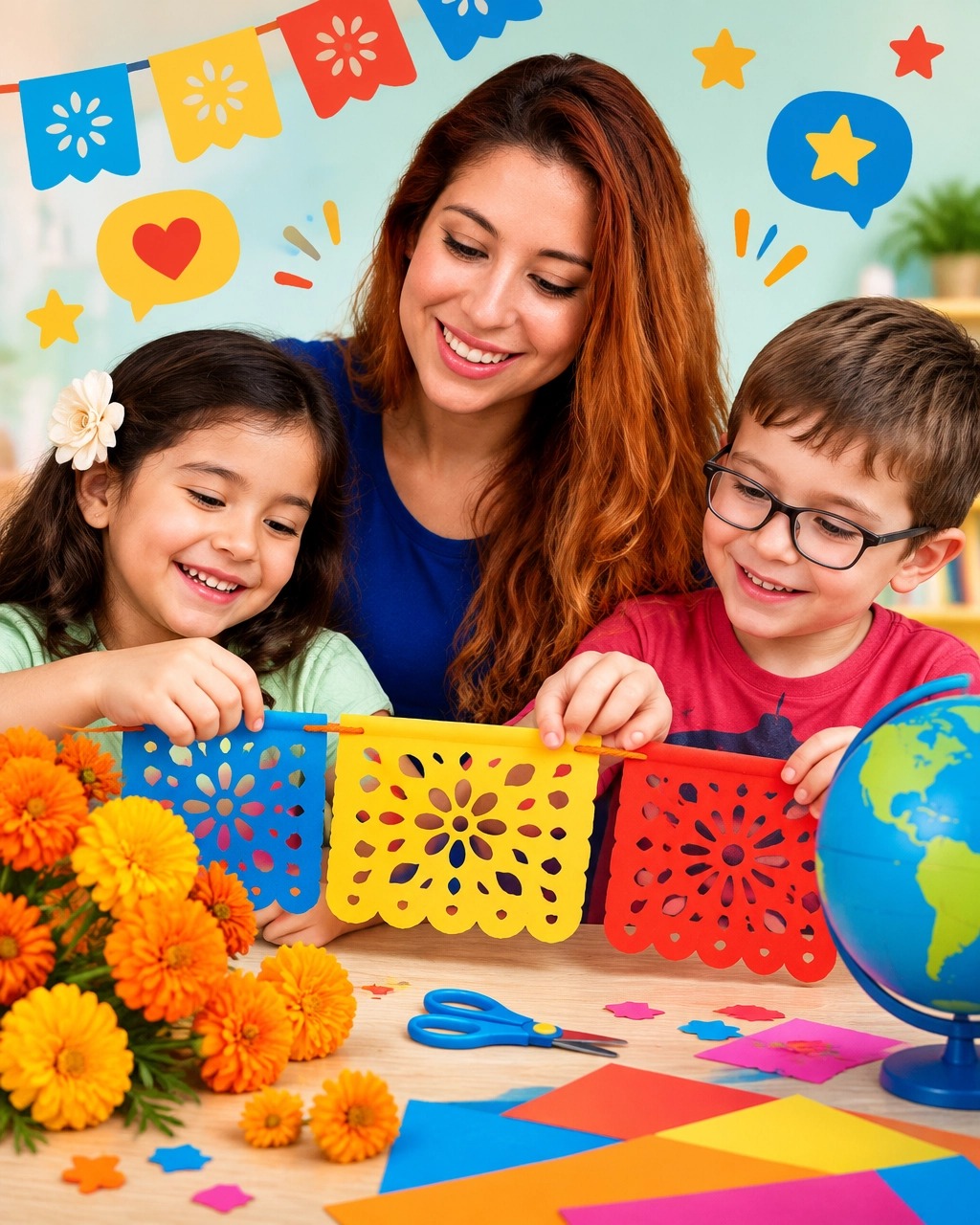
Papel picado is a traditional Mexican paper-cutting art often used as festive decoration. Kids can make a simple version with tissue paper or construction paper.
Fold the paper. Cut small shapes along the edges. Open it carefully. Then attach several pieces to string.
While you work, practice colors:
-
rojo , red
-
amarillo , yellow
-
azul , blue
-
verde , green
-
naranja , orange
Explain that papel picado can appear at many celebrations. It is more meaningful when children learn where the tradition comes from instead of treating it as a random craft.
3. Learn about cempasúchil, the marigold flower
Marigolds are called cempasúchil in Mexico. Their bright orange and yellow colors are especially associated with Día de los Muertos, which takes place during this season.
Look at a real flower or a picture together. Talk about:
-
Its color and scent
-
Where marigolds grow
-
How flowers can carry cultural meaning
-
Why different families celebrate traditions in different ways
You can draw the flower and label it la flor de cempasúchil.
A respectful note for children: Día de los Muertos is not simply “Mexican Halloween.” It is a meaningful tradition centered on remembering and honoring loved ones. Keep the conversation warm, ageappropriate, and focused on real cultural context.
4. Play a bilingual Lotería game
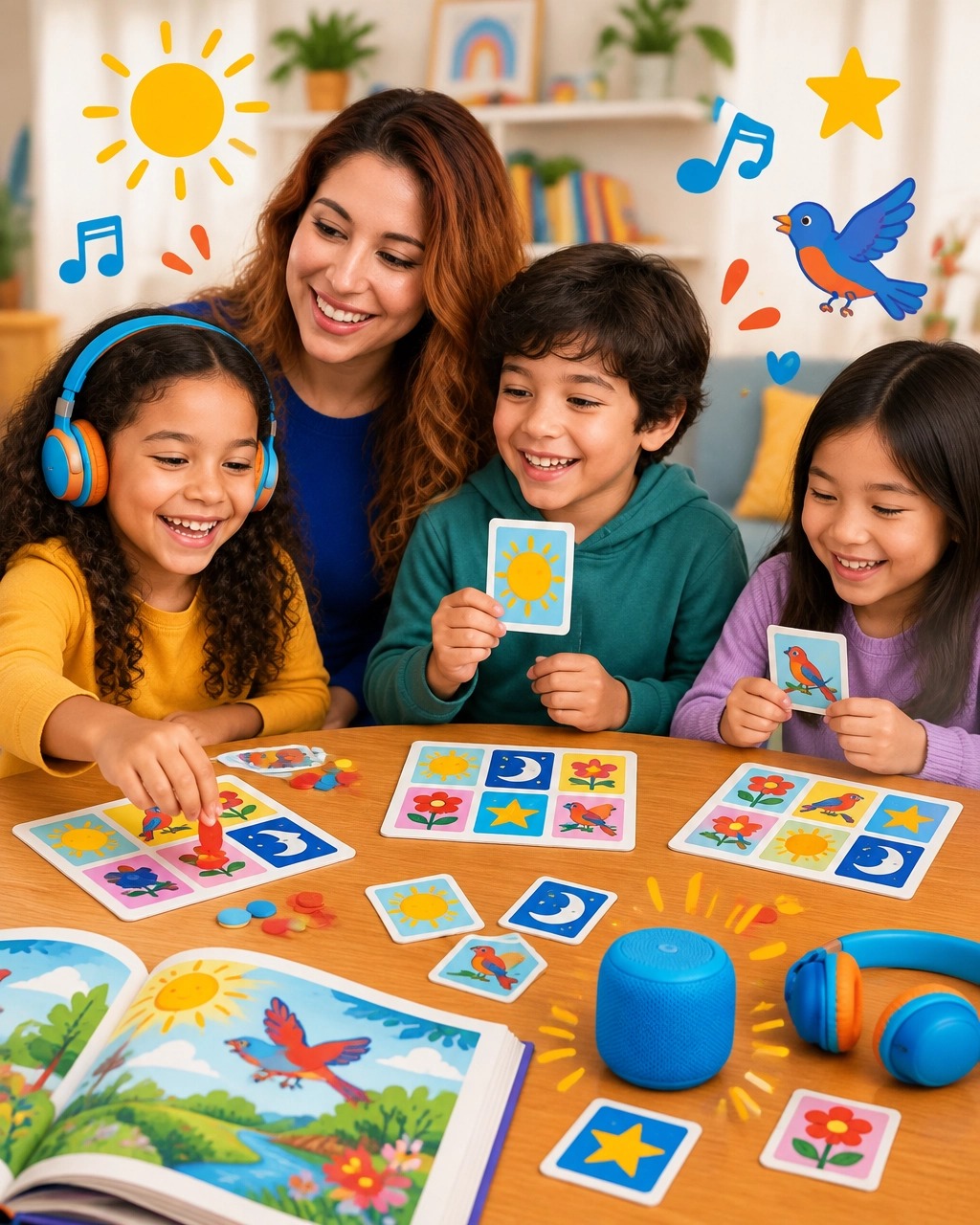
Lotería is a traditional Mexican picture game. It is similar to bingo, but it uses illustrated cards instead of numbered balls.
Use picture cards or create your own with simple images:
-
el sol , the sun
-
la luna , the moon
-
la estrella , the star
-
el árbol , the tree
-
la rana , the frog
-
el corazón , the heart
Call out each word in Spanish and English. Encourage children to repeat it before covering the matching picture.
This is an easy way to build vocabulary without worksheets. ¡Qué divertido!
5. Try our Spanish Bingo printable
Want a ready-to-use activity? We have a Spanish Bingo printable available for families. It is a playful way to practice greetings, colors, animals, food, and everyday vocabulary.
Use it during family game night, a homeschool morning, or a Spanish-themed playdate. Children can mark spaces with buttons, cereal pieces, stickers, or small toys.
For access information and more family-friendly Spanish resources, visit Spanish.education and mention the Spanish Bingo printable.
6. Enjoy a bilingual read-aloud
Choose a children’s book by a Spanish-speaking or Latino author or illustrator. You can read it in Spanish, English, or both.
Try this simple routine:
1.Look at the cover and predict what will happen. 2.Read one page in Spanish. 3.Retell the idea in English. 4.Ask your child to repeat one favorite word. 5.Celebrate the pictures, characters, and feelings.
Do not worry about translating every sentence. Even a few Spanish words can build confidence.
Libraries often curate excellent book lists for Hispanic Heritage Month. The New York Public Library’s Hispanic and Latinx Heritage Month resources are a helpful place to discover more ideas.
7. Turn up the music and dance
Music makes Spanish memorable! Listen to different styles connected to different places.
You might explore:
-
Mariachi from Mexico
-
Salsa from the Caribbean
-
Merengue from the Dominican Republic
-
Cumbia from Colombia
-
Tango from Argentina
-
Flamenco from Spain
Ask your child to listen for the beat, instruments, and mood. Then dance freely!
Practice movement words as you go:
-
baila , dance
-
salta , jump
-
gira , turn
-
aplaude , clap
There is no perfect choreography. Just move, smile, and say “¡Viva la música!”
8. Play “Mar y Tierra”
This no-prep listening game is perfect for preschoolers and elementary-age children.
Choose one side of the room as mar and the other as tierra. Call out one word at a time. Your child jumps to the correct side. Start slowly:
-
¡Mar!
-
¡Tierra!
Then switch it up. Whisper the words. Say them faster. Let your child become the caller.
This activity supports listening comprehension, movement, and confidence, especially for children just beginning Spanish.
9. Make a simple food tasting plate
Food is a delicious way to explore culture, but remember that no single dish represents an entire country.
Try a small tasting plate with foods inspired by different Spanish-speaking regions:
-
Corn tortillas or quesadillas
-
Fresh fruit
-
Rice and beans
-
Empanadas
-
Plantains
-
Pan con tomate
-
Arepas
Talk about ingredients, flavors, and family traditions. Practice phrases such as:
-
Me gusta , I like it
-
No me gusta todavía , I do not like it yet
-
Está delicioso , It is delicious
-
¿Qué es? , What is it?
Children never need to taste something they do not want to try. Curiosity works best without pressure!
10. Start a Spanish phrase jar
Write easy Spanish phrases on scraps of paper and place them in a jar.
Include:
-
¡Hola! , Hello!
-
¿Cómo estás? , How are you?
-
Gracias , Thank you
-
Por favor , Please
-
Me llamo… : My name is…
-
¡Vamos! : Let’s go!
-
Hasta luego : See you later!
Pull out one phrase each day. Use it naturally at breakfast, during play, or before bedtime.
11. Take a virtual tour
You do not need a plane ticket to explore Spanish-speaking places. Look at virtual museum tours, maps, videos, and photographs together.
Visit landmarks and places connected to:
-
Mexico City
-
Madrid
-
Bogotá
-
Lima
-
Buenos Aires
-
Santo Domingo
Ask your child, “¿Qué ves?”: What do you see?
For a live, child-friendly experience, explore our Spanish virtual tour of Frida Kahlo’s house, led by a Spanish teacher from Mexico.
12. Meet an inspiring Spanish-speaking person
Choose one artist, writer, scientist, athlete, leader, or explorer connected to a Spanish-speaking community.
Children can create a mini poster with:
-
The person’s name
-
Where they are from
-
What they contributed
-
One reason they feel inspired
Choose people from different countries and fields. This helps children see Hispanic heritage as a living story of creativity, courage, discovery, and achievement.
13. Make a family map and postcard
Draw a map or print a simple world map. Mark several Spanish-speaking countries with stickers. Then ask your child to design a postcard from one location. They can draw a landscape, building, animal, or food and write:
Saludos desde Colombia. Greetings from Colombia.
Younger children can dictate the sentence. Older children can write three or four lines in Spanish.
14. Have a Spanish movie or story night
Choose an age-appropriate film, short animation, or storytelling video connected to a Spanish-speaking country. Keep the language level comfortable.
Before watching, teach three words to listen for. Afterward, ask:
-
What did you notice?
-
Which character did you like?
-
What words did you recognize?
-
What would you like to learn next?
A few minutes of Spanish listening can make a big difference. Keep it relaxed and joyful.
15. Join an interactive Spanish class
At-home activities are wonderful. Live interaction gives children a chance to use Spanish with real people.
In our interactive Spanish lessons for children, native Spanish-speaking teachers use games, songs, stories, movement, culture, and conversation. Children can participate at their own level: from first words to advanced speaking.
We offer:
-
Preschool Spanish classes online
-
Live group classes for ages 3–18
-
One-on-one tutoring
-
Spanish culture and music classes
-
Ongoing courses and conversation clubs
-
Virtual tours and seasonal programs
Explore Spanish the Fun Way Academy on Outschool and use code SPANISH20 when you enroll. ¡Vámonos!
Celebrate curiosity, connection, and joy
Hispanic Heritage Month is not about squeezing an entire continent of cultures into one month. It is an invitation to keep learning all year long.
Choose one activity. Play one game. Listen to one song. Read one story. Say one new phrase.
Most importantly, make space for real voices, diverse traditions, and your child’s questions. When Spanish learning feels welcoming and fun, children build something powerful: confidence, curiosity, and a genuine love for language. ❤
¡Feliz Hispanic Heritage Month, amigos!