Spanish Milestones by Age: What Your Child Should Learn First (A Teacher's Roadmap for Ages 3-12)
10 de septiembre de 2026
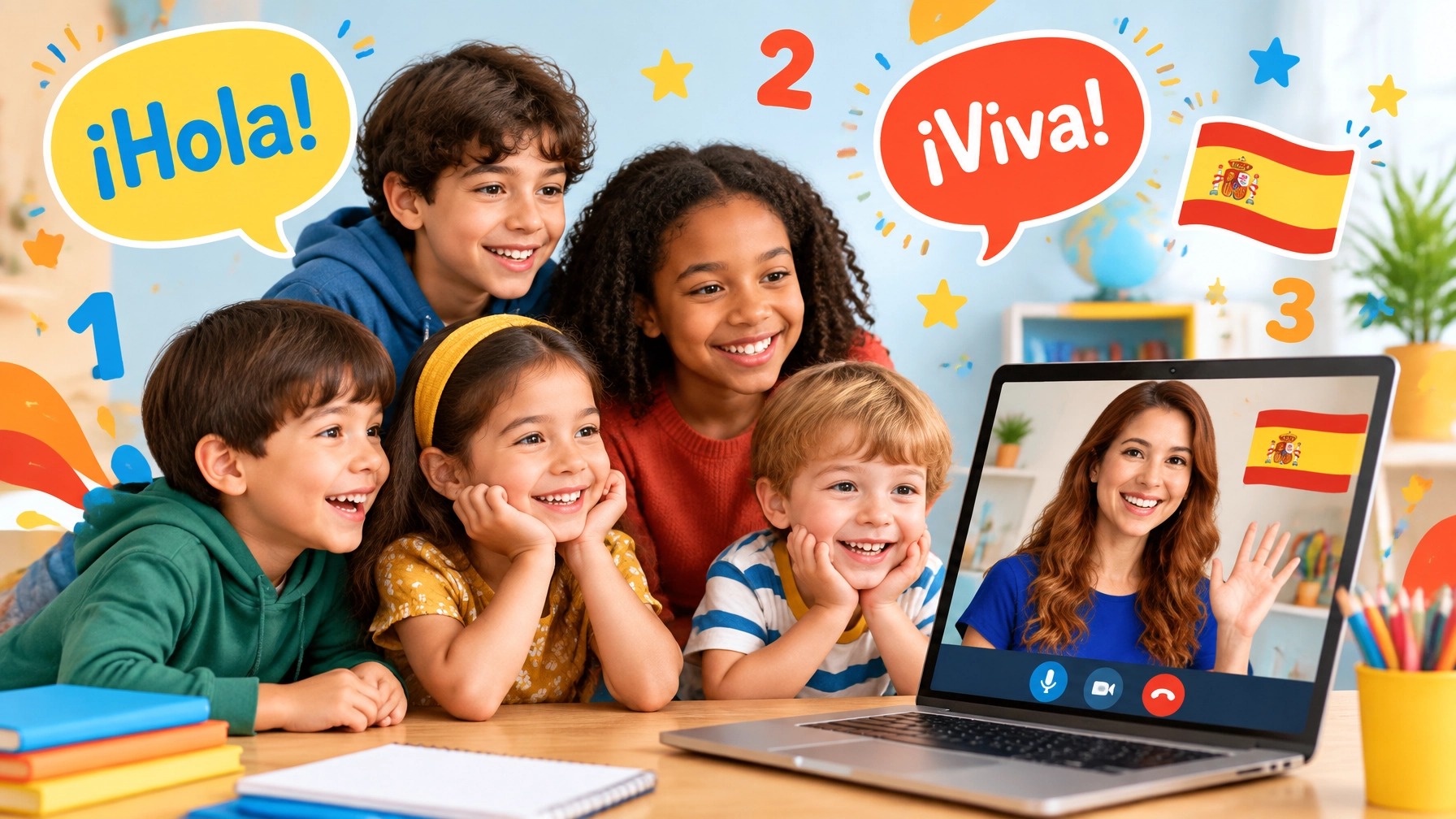
“Is my child on track with Spanish?”
Teacher Susie hears this question all the time. And the reassuring answer is this: Spanish learning is not a race! Every child develops at a different pace. Exposure, confidence, class frequency, age, and personality all matter.
A child who listens quietly may be learning a lot. A child who speaks quickly may still be building comprehension. Both paths can be perfectly healthy. ¡De verdad!
This roadmap gives you realistic Spanish milestones by age. Use it as a friendly guide, not a test. Con- sistency beats perfection every time.
Important: Language milestones depend more on years and quality of exposure than on age alone. A child beginning Spanish at age 9 may show different progress from a child who started at age 3.
First things first: comprehension comes before speaking
Many children experience a silent period, also called the período de silencio. During this stage, your child may understand Spanish without speaking it much.
They may:
-
Point to the correct picture.
-
Follow a classroom instruction.
-
Nod or shake their head.
-
Recognize familiar songs and phrases.
-
Understand greetings before using them.
-
Watch carefully and participate through movement.
-
Answer with gestures, drawing, or a single word.
This is not laziness. It is not failure. Their brain is gathering sounds, vocabulary, rhythm, and meaning.
You can support this stage by offering plenty of warm, comprehensible input. Avoid pressuring your child to repeat every word. A relaxed child is much more likely to speak when they feel ready. Poco a poco, little by little!
For more background, see Colorín Colorado’s overview of language acquisition.
Ages 3–4: Spanish through songs, movement, and play
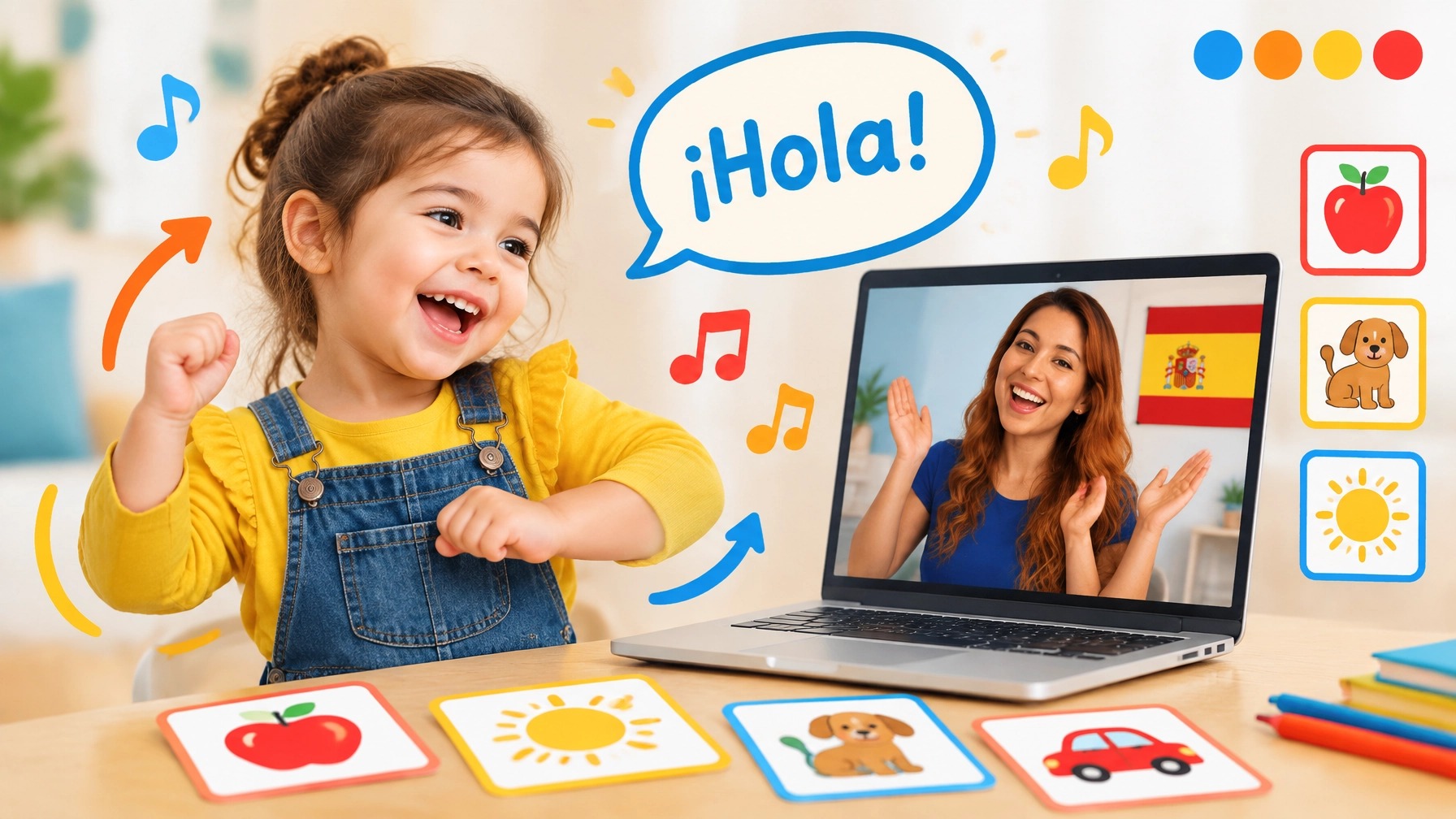
At ages 3–4, children learn best through their whole bodies. They need to move, sing, point, laugh, and play. That is why excellent preschool Spanish classes online should feel active and joyful, not like a worksheet session.
Realistic goals
Your preschooler may begin to:
-
Respond to “¡Hola!” and “¡Adiós!”
-
Recognize their name in Spanish.
-
Understand simple classroom directions such as ven, mira, escucha, and siéntate.
-
Identify familiar colors such as rojo, azul, verde, and amarillo.
-
Count from 1–5, or gradually toward 10.
-
Join in with songs and repeated phrases.
-
Answer yes-or-no questions using sí and no.
-
Point to animals, toys, body parts, or objects when named.
-
Use a few memorized phrases such as me gusta, más, or agua.
What is not required yet
Your child does not need to:
-
Speak in complete sentences.
-
Pronounce every sound perfectly.
-
Translate Spanish into English.
-
Read or write Spanish.
-
Answer every teacher question aloud.
-
Remember every color or number after one lesson.
For some preschoolers, listening and joining the actions are the main achievements. That counts! A child who sings part of Hola, hola today may surprise you with a full phrase weeks later.
What helps most
Look for playful Spanish instruction with:
-
Songs and chants.
-
Movement games.
-
Puppets and stories.
-
Colorful objects.
-
Repetition without pressure.
-
Short activities that change often.
A strong program should build curiosity and love for Spanish first. Worksheets can wait. ¡A jugar!
Ages 5–6: From familiar words to useful phrases
By ages 5–6, many children are ready to connect familiar vocabulary into short phrases. They still need plenty of games and repetition, but they can begin using Spanish for simple classroom communication.
Realistic goals
Your child may be able to:
-
Greet someone and say goodbye.
-
Say their name: Me llamo Ana.
-
Say how they feel: Estoy feliz or Estoy cansado/cansada.
-
Count to 10 or 20 with support.
-
Name common colors, animals, foods, and family members.
-
Answer ¿Cómo estás? with a memorized or partly independent response.
-
Say what they like: Me gusta el chocolate.
-
Follow two-step instructions with visual support.
-
Ask for a favorite item using Quiero…
-
Recognize simple Spanish words in books, labels, or games.
What is realistic, and what is not
It is realistic to expect short answers, repeated sentence frames, and growing confidence.
It is not realistic to expect adult-like grammar or spontaneous conversation about unfamiliar topics. Mistakes are normal. In fact, mistakes often show that your child is taking risks with the language.
Try expanding rather than correcting:
-
Child: Rojo.
-
Adult: Sí, es rojo. El coche es rojo.
That gentle modeling gives your child more language without interrupting the fun.
Ages 6–8: Building complete sentences
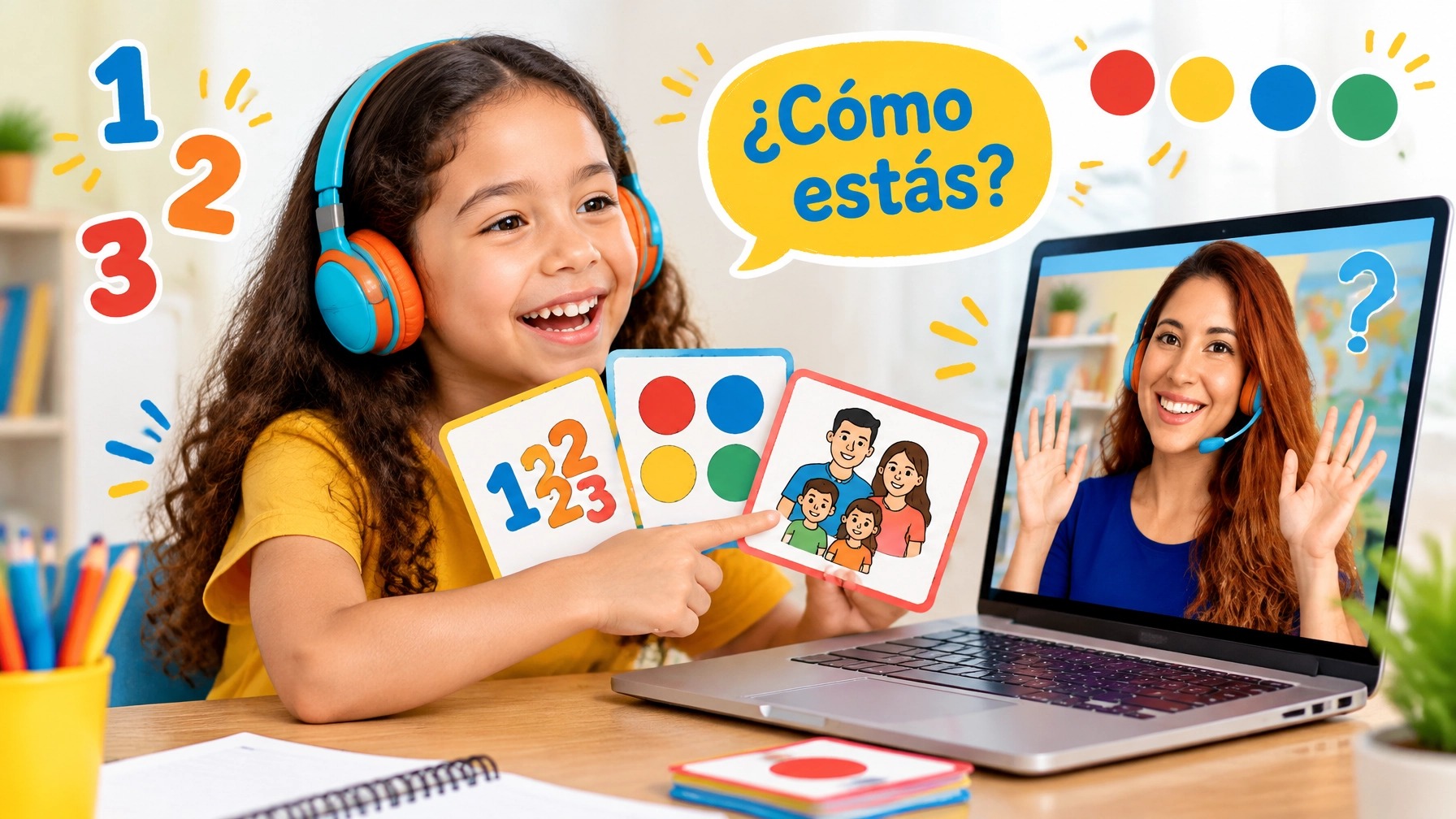
This is an exciting stage for children using an elementary Spanish curriculum online. They can begin moving from vocabulary practice to meaningful communication.
Realistic goals
With regular exposure, a child ages 6–8 may:
-
Introduce themselves with several details.
-
Say their age and where they live.
-
Talk about family, pets, hobbies, and school.
-
Answer simple questions in full sentences.
-
Ask questions such as ¿Qué es?, ¿Dónde está?, and ¿Te gusta…?
-
Use numbers for age, counting, prices, or simple games.
-
Describe objects with colors and size.
-
Express likes and dislikes: Me gusta jugar, No me gusta el pescado.
-
Follow familiar stories and classroom routines.
-
Retell a short event using sentence starters.
-
Understand the main idea of a simple conversation.
A developing speaker might say:
Me llamo Leo. Tengo siete años. Me gusta Minecraft y mi color favorito es el azul.
That is wonderful progress: even if the grammar is still developing!
What may still take time
Your child may not yet:
-
Understand every word in a fast conversation.
-
Speak Spanish for an entire class without English support.
-
Use verb endings accurately every time.
-
Read chapter books independently.
-
Explain complex opinions.
Aim for communication, not perfection. If your child can get a message across, celebrate it: ¡Muy bi- en!
Ages 9–12: Expanding conversation and confidence
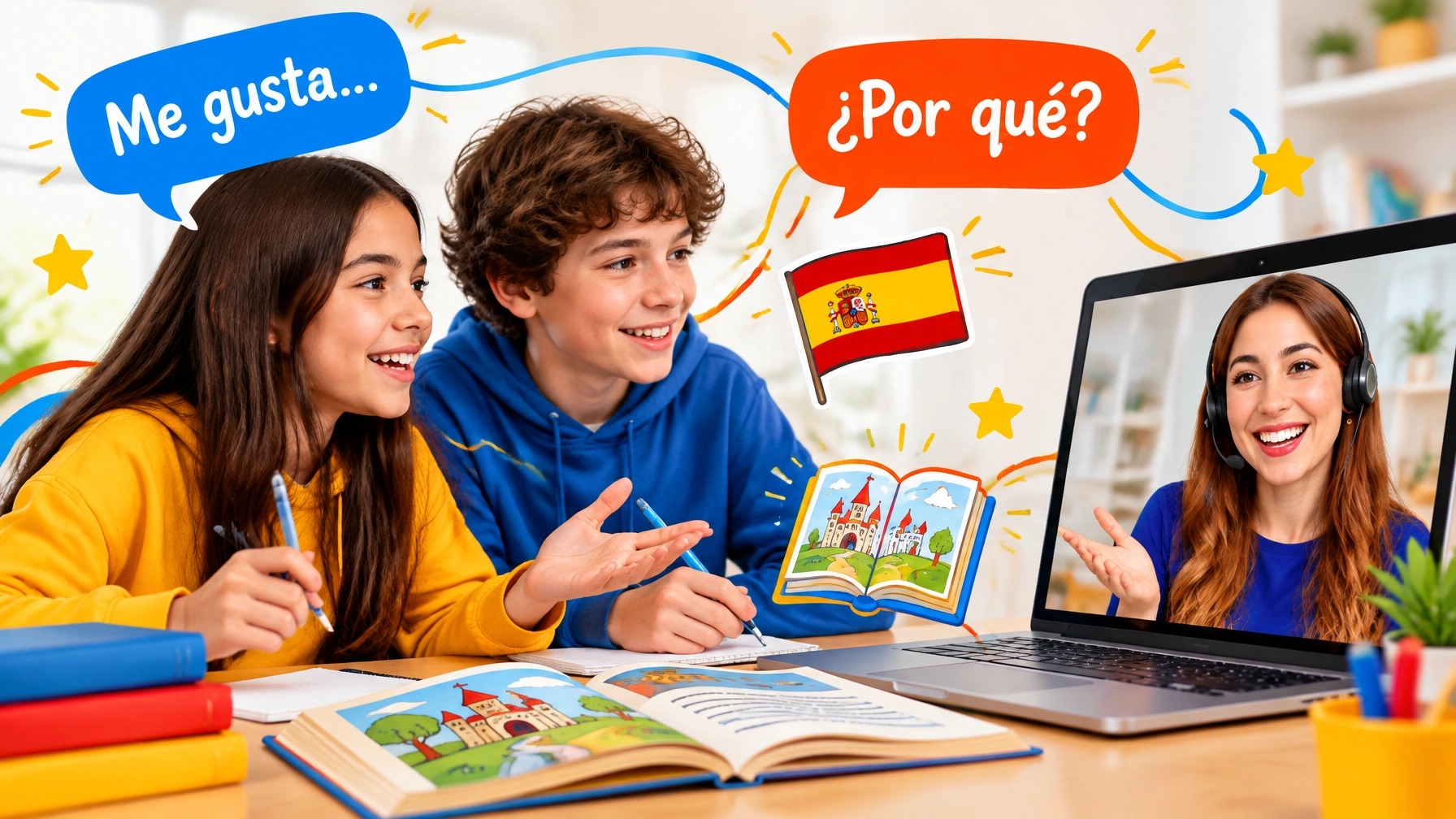
Between ages 9 and 12, many learners are ready for more authentic conversation. They can still enjoy games, but they also benefit from stories, culture, projects, virtual tours, music, and opinion-based activities.
Realistic goals
With consistent learning, your child may begin to:
-
Hold a short conversation about familiar topics.
-
Answer who, what, where, when, and why questions.
-
Ask follow-up questions.
-
Describe people, places, routines, and experiences.
-
Give opinions: Creo que…, Me parece…, or En mi opinión…
-
Explain preferences and reasons.
-
Retell a story with a beginning, middle, and end.
-
Compare two things using simple language.
-
Use longer sentences with connecting words such as y, pero, and porque.
-
Read short passages and identify the main idea.
-
Write a short paragraph about themselves or a familiar topic.
-
Understand more natural classroom conversation.
What may not happen immediately
Even a confident 10-year-old may still need support with:
-
Fast native-speaker conversations.
-
Slang and regional expressions.
-
Academic vocabulary.
-
Irregular verbs.
-
Speaking spontaneously under pressure.
-
Writing long, grammatically perfect paragraphs.
That is completely normal. Everyday fluency and academic fluency develop at different speeds.
A printable Spanish “can-do” checklist
Print this list and celebrate the skills your child can do now. Leave the others for later!
My child can…
-
Say hello and goodbye in Spanish.
-
Say their name.
-
Say how they feel.
-
Count to 10.
-
Name several colors.
-
Name family members, animals, or foods.
-
Follow simple Spanish instructions.
-
Understand a familiar Spanish song.
-
Answer ¿Cómo estás?
-
Say what they like and dislike.
-
Ask a simple question.
-
Answer using a full sentence.
-
Describe a person or object.
-
Talk about a daily routine.
-
Retell part of a story.
-
Give a simple opinion.
-
Ask a follow-up question.
-
Read a short Spanish passage.
-
Write a few connected sentences.
A child does not need every box checked. Progress can look like understanding a new phrase, joining a song, or finally speaking to the teacher after weeks of listening.
How to help your child stay on track
The best plan is one your family can maintain.
-
Choose regular Spanish exposure.
-
Keep practice short and enjoyable.
-
Read, sing, play, and talk about everyday life.
-
Celebrate effort: not just correct answers.
-
Let your child listen without demanding speech.
-
Use Spanish in meaningful routines.
-
Pick classes that match your child’s age and personality.
-
Give your child opportunities to speak with a real teacher.
If you are looking for Learn Spanish for children online, Spanish the Fun Way Academy on Outschool offers live, interactive classes for preschoolers, elementary learners, tweens, and teens. Native Spanish-speaking teachers use stories, games, songs, culture, and conversation to help children speak with confidence.
You can also explore additional Spanish learning resources at Spanish.education. Ready to make Spanish part of your child’s week? Use promo code SPANISH20 when eligible and take the next step toward joyful, consistent learning. Some class spots are limited, so ¡vamos! Find a fun fit for your child today! 💛🇪🇸
Spanish milestones FAQ
Is my child behind if they understand Spanish but do not speak it?
Not necessarily. Your child may be experiencing the silent period, a normal stage in second-language learning. Comprehension often develops before speaking. Continue offering relaxed, meaningful Spanish without pressure.
What should a 3-year-old learn in Spanish?
A 3-year-old can begin with greetings, songs, colors, numbers, simple directions, animal names, and useful phrases such as más, agua, and me gusta. Play and movement are more appropriate than long worksheets.
How long does it take children to learn Spanish?
There is no single timeline. Progress depends on age, frequency of exposure, class quality, opportunities to speak, and each child’s personality. Consistent weekly learning can build a strong foundation, while more frequent exposure usually creates more opportunities to understand and communicate.
Should my child speak Spanish in every class?
No. Listening, moving, pointing, and joining activities are valuable forms of participation. A child may be learning actively even when they are not speaking much yet.
What is the best Spanish curriculum for elementary children?
Look for an elementary Spanish curriculum online that combines structured progression with live interaction, stories, games, cultural learning, and chances to answer real questions. The best curriculum is one your child enjoys and can follow consistently.
How can I support Spanish learning at home if I do not speak Spanish?
Use songs, picture books, labeled objects, short audio clips, and teacher-provided phrases. You do not need to be fluent. Your encouragement and consistency matter enormously. ¡Sí, se puede!