Spanish Slang for Teens: 30 Phrases to Sound Like a Local (Not Like a Textbook)
10 de septiembre de 2026
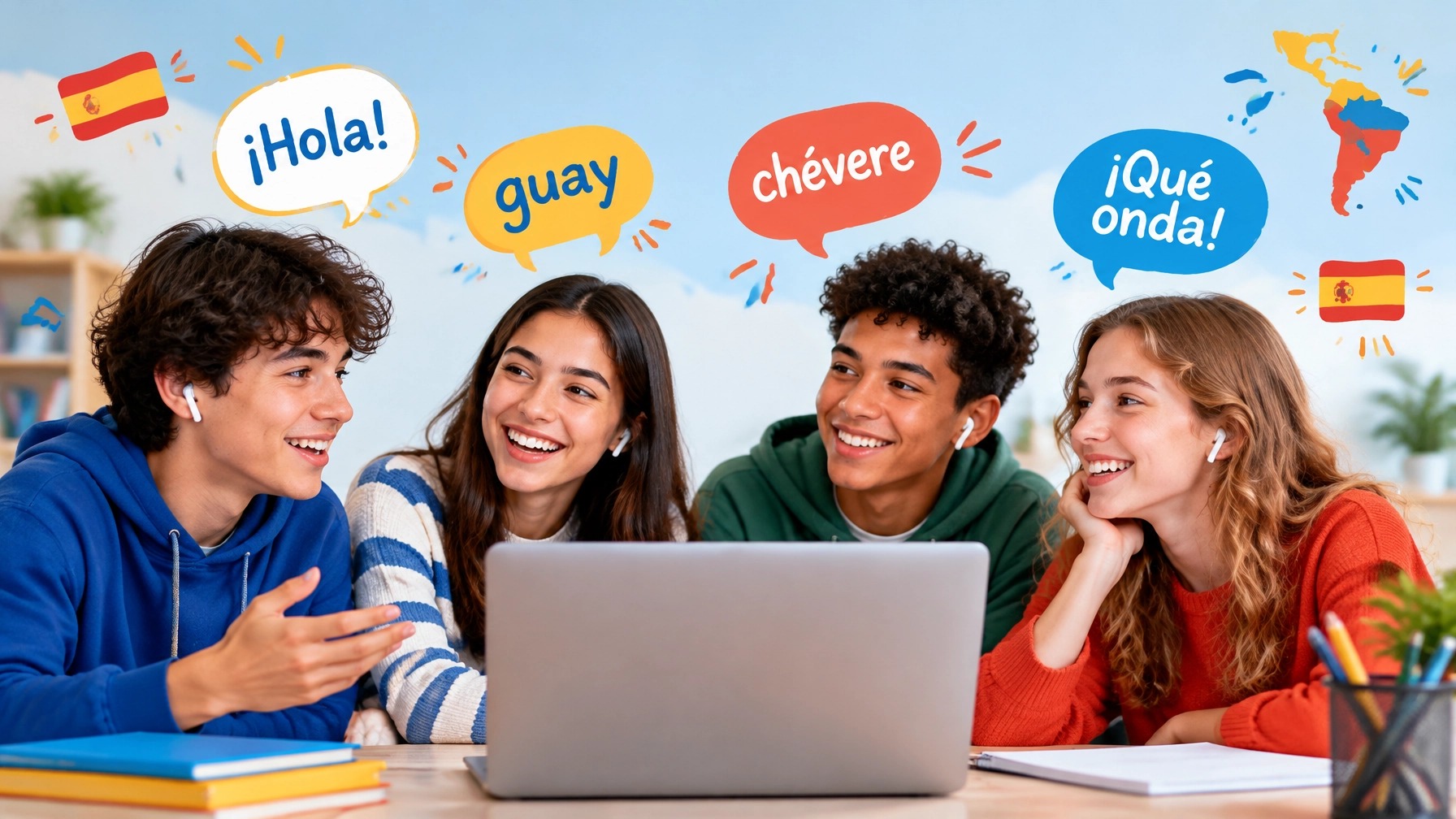
“¿Cómo estás?” is useful. But if you want to sound more natural in real conversations, Spanish slang is your next adventure! 🌎✨
Slang helps you understand what teens actually say in Spain and Latin America. It can make Spanish feel more relaxed, current, and fun.
But there’s one important rule: slang changes by country, city, age, and situation. A phrase that sounds friendly in Mexico may sound confusing in Spain. A word that works with friends may not be appropriate with a teacher or grandparent.
Ready to level up your Spanish for teens online? ¡Vamos!
Before You Use Spanish Slang: Three Quick Rules
1. Slang is for casual situations
Use these expressions with friends, classmates, siblings, or people your age. Use standard Spanish when you are:
-
Speaking with a teacher
-
Writing a school assignment
-
Meeting someone for the first time
-
Talking to grandparents or adults you do not know well
-
Giving a presentation
-
Writing a formal email
2. Listen before you copy
Native speakers can help you understand whether a phrase sounds current, funny, old-fashioned, friendly, or too informal. That is one reason live conversation practice is so valuable!
3. Regional Spanish is full of surprises
Spanish is spoken across more than 20 countries. ¡Qué chévere! The same idea may have several different slang words depending on where you are.
The examples below are teen-friendly and useful for casual conversations.

Spanish Slang from Spain
These phrases are especially common in casual Spanish from Spain.
1. Tío / tía
Meaning: Dude, mate, girl, or person.
Example: Oye, tío, mira este vídeo. “Hey, dude, look at this video.”
Although tío literally means “uncle,” young people in Spain often use it to address a friend or another person casually.
2. Guay
Meaning: Cool, great, awesome. Example: Tu nueva mochila está muy guay. “Your new backpack is really cool.”
This is one of the safest and most widely understood informal words in Spain.
3. Molar
Meaning: To be cool or to like something.
Example: Me mola mucho esa canción. “I really like that song.”
Notice that molar works differently from English “to like.” You can say me mola to mean “I like it.”
4. Mazo
Meaning: A lot, loads, or very much.
Example: Hay mazo de gente en el concierto. “There are loads of people at the concert.”
Mazo is particularly associated with informal speech in Madrid and nearby areas.
5. Chaval / chavala
Meaning: Kid, teen, young person, or guy/girl.
Example: Ese chaval va a mi clase. “That guy is in my class.”
It is casual and common, but you may not want to use it in a formal conversation.
6. Flipar
Meaning: To be amazed, shocked, or blown away.
Example: Estoy flipando con el final de la serie. “I’m amazed by the ending of the series.”
You can also say ¡Flipa! as an informal reaction meaning “No way!” or “You’ve got to see this!”
7. Vale
Meaning: Okay, sure, all right.
Example: ¿Quedamos a las seis? , Vale. “Shall we meet at six? , Okay.”
People of all ages use vale, but you will hear it constantly in everyday Spanish from Spain.
8. Me renta / no me renta
Meaning: It is worth it / it is not worth it. Example: Ir tan lejos no me renta. “Going that far isn’t worth it to me.”
This is a modern, informal way to talk about whether something is worth your time, money, or effort.
Spanish Slang from Mexico
Mexican Spanish has many expressive, friendly phrases. Tone matters, so listen carefully to how people use them.
9. Chido / chida
Meaning: Cool, nice, awesome.
Example: Está bien chida tu camiseta. “Your shirt is really cool.”
Chido is a classic casual word in Mexico.
10. Padrísimo / padrísima
Meaning: Super cool, fantastic, amazing.
Example: La excursión estuvo padrísima. “The field trip was amazing.”
It is stronger and more enthusiastic than simply saying bien or bueno.
11. Órale
Meaning: Okay, come on, wow, or let’s go.
Example: ¿Ya nos vamos? , ¡Órale! “Are we leaving? , Let’s go!”
The meaning depends on the situation and the speaker’s tone.
12. ¿Qué onda?
Meaning: What’s up? How’s it going?
Example: ¡Qué onda! ¿Cómo te fue en el examen? “What’s up! How did your exam go?”
This is a very natural casual greeting among friends in Mexico.
13. La neta
Meaning: Honestly, seriously, or the truth.
Example: La neta, no entendí la tarea. “Honestly, I didn’t understand the homework.” You may also hear ¿Neta? meaning “Really?” or “Seriously?”
14. Buena onda
Meaning: Nice, friendly, or good vibes.
Example: Tu entrenador es muy buena onda. “Your coach is really nice.”
It can describe a person, a place, or a situation.
15. Fresa
Meaning: Preppy, posh, or someone with a fancy style.
Example: Ese restaurante es un poco fresa. “That restaurant is a little fancy/preppy.”
This word can be playful or teasing. Avoid using it to label someone unless you understand the relationship and tone.
16. No manches
Meaning: No way, you’re kidding, or come on!
Example: ¡No manches! ¿Ganaste el concurso? “No way! Did you win the contest?”
It is a mild, informal expression. It is much safer for teen learners than stronger versions you may hear elsewhere.

Spanish Slang from Argentina
Argentine Spanish has a distinctive rhythm and vocabulary. You will often hear these words in casual conversations, videos, music, and shows.
17. Che
Meaning: Hey, mate, or listen.
Example: Che, ¿viste la nueva película? “Hey, did you see the new movie?”
Che is strongly associated with Argentina and is friendly in everyday conversation.
18. Piola
Meaning: Cool, nice, or easygoing.
Example: Tu idea está re piola. “Your idea is really cool.”
It can describe people, plans, music, places, or ideas.
19. Copado / copada
Meaning: Cool, awesome, or great.
Example: Qué copado el campamento. “The camp is so cool.”
This is another positive word you can use when you want to sound enthusiastic.
20. Chabón / chabona
Meaning: Guy, girl, or young person.
Example: Ese chabón juega muy bien al fútbol. “That guy plays football really well.”
It is informal and should be saved for casual conversations.
21. Fiaca
Meaning: Laziness or not feeling like doing something.
Example: Tengo fiaca para ordenar mi habitación. “I don’t feel like tidying my room.”
You can use tener fiaca when you are low on motivation.
22. Re
Meaning: Really, very, or super.
Example: La tarea está re fácil. “The homework is super easy.”
In Argentina, re is a popular intensifier. It goes before an adjective or adverb.
23. Posta
Meaning: For real, honestly, or seriously.
Example: Posta, esa fue la mejor parte del viaje. “Honestly, that was the best part of the trip.”
You may also hear ¿Posta? as “Really?”
24. Bancar
Meaning: To support, tolerate, or put up with something.
Example: Gracias por bancarme durante el examen. “Thanks for supporting me during the exam.”
With friends, te banco can mean “I’ve got your back.”
Spanish Slang from Colombia
Colombian Spanish includes warm, expressive phrases that are especially useful in friendly conversations.
25. Bacano / bacana
Meaning: Cool, awesome, or great.
Example: Qué bacano tu proyecto. “Your project is awesome.”
This is one of the most recognizable casual words in Colombia.
26. Chévere
Meaning: Cool, excellent, or great.
Example: La clase estuvo muy chévere. “The class was really great.”
You may hear chévere in several Latin American countries, not only Colombia.
27. Parce / parcero / parcera
Meaning: Buddy, bro, or close friend.
Example: ¿Qué más, parce? “What’s up, bro?”
It is friendly and very informal. Use it with people you know well.
28. ¿Qué más?
Meaning: What’s up? How’s it going? Example: ¡Qué más! ¿Todo bien? “What’s up! Everything good?”
This does not literally mean “what else?” in this context. It is a casual Colombian greeting.
29. Chino / china
Meaning: Kid, child, or young person.
Example: Los chinos están jugando en el parque. “The kids are playing in the park.”
In Colombia, this word does not necessarily refer to someone from China.
30. De una
Meaning: Definitely, sure, or absolutely.
Example: ¿Quieres ir al cine? , ¡De una! “Do you want to go to the cinema? , Absolutely!”
It is positive, quick, and useful across many casual Spanish-speaking conversations.
How to Sound Natural Without Overdoing Slang
The goal is not to fill every sentence with slang. ¡No hace falta! Natural Spanish means knowing when to use casual expressions and when to choose standard Spanish.
Try this simple approach:
-
Learn the standard word first.
-
Add one regional expression at a time.
-
Notice who is speaking and where they are from.
-
Ask a native speaker if a phrase sounds natural.
-
Avoid mixing slang from five countries in one conversation.
-
Use standard Spanish with teachers, grandparents, and in formal settings.
-
Let your personality lead. You do not need to sound “perfect” to sound natural!
For more regional language inspiration, explore guides from Sampere on Spanish expressions used by teens and Berlitz’s Spanish slang overview.
Ready to Practice Spanish Slang Live?
Knowing a phrase is one thing. Using it confidently is another! That is where live conversation makes a huge difference.
Our B1–C1 Conversation Clubs for Teens give learners a welcoming place to:
-
Practise real-world Spanish
-
Speak with native Spanish teachers
-
Discuss music, films, culture, travel, and teen life
-
Build confidence in small interactive groups
-
Learn when slang sounds natural, and when standard Spanish is better
At Spanish the Fun Way Academy, our Native Spanish teachers for kids and teens make language learning active, friendly, and engaging. Our Interactive Spanish lessons for children and teens are designed to get learners speaking from day one. ¡Viva el español! 🇪🇸🌎
Explore the B1–C1 Conversation Clubs for Teens on Outschool, or visit spanish.education for more Spanish-learning resources.
Use promo code SPANISH20 when you enrol or contact the academy for details. Spots in live conversation groups can fill fast, so ¡vamos! Give your teen a fun way to speak more naturally, make mistakes bravely, and discover the Spanish they will actually use. 💬✨
Frequently Asked Questions
Is Spanish slang appropriate for teens?
Yes, when it is age-appropriate and used in the right context. Teens should learn that slang is informal and can vary by country. Some expressions are friendly with classmates but inappropriate with teachers or in formal situations.
What is the best way to learn Spanish slang?
The best way is to combine short vocabulary lists with live practice. Native Spanish teachers can explain pronunciation, tone, regional differences, and whether a phrase sounds current or outdated.
Should teens use slang in Spanish class?
They can practise slang in conversation activities, role plays, and cultural discussions. However, they should use standard Spanish for formal writing, presentations, and academic assignments unless their teacher says otherwise.
Are Spanish slang words the same in every country?
No. Spanish slang is highly regional. For example, “cool” may be guay in Spain, chido in Mexico, copa- do in Argentina, or bacano in Colombia.
What level of Spanish is helpful for learning slang?
Intermediate learners around B1 can begin learning common slang with support. B2–C1 learners can explore nuance, tone, humour, and regional differences in greater depth.